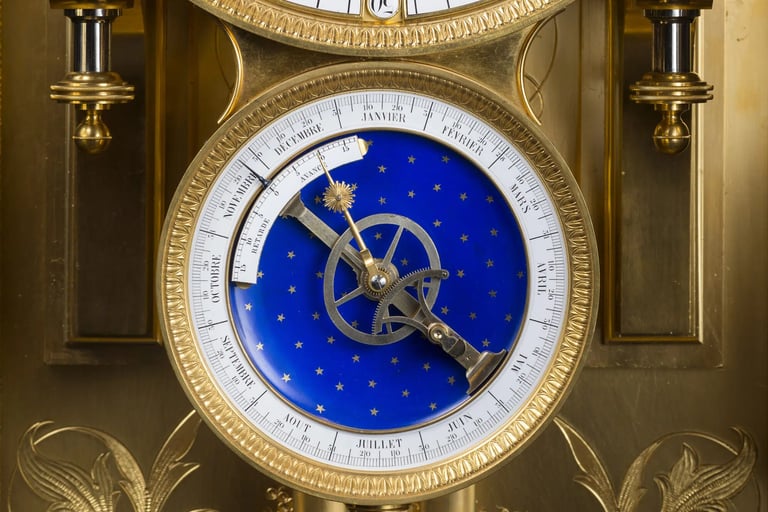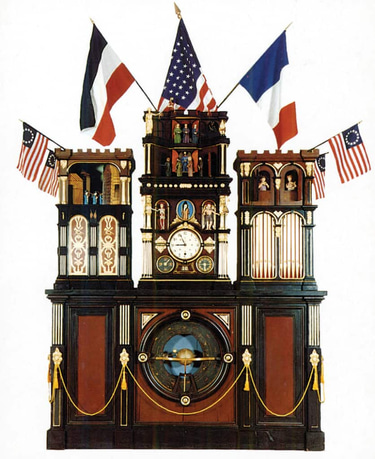
Louis XIV (1661 - 1715)
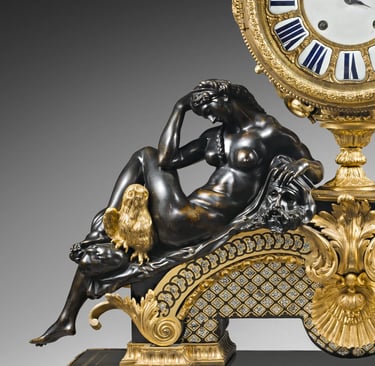
Key Characteristics:
Baroque Grandeur: Extravagant and elaborate designs showcasing wealth and status.
Boulle Technique: Masterful marquetry using contrasting materials (tortoiseshell, ebony, brass, mother-of-pearl) for intricate patterns, popularized by André-Charles Boulle.
Materials: Luxurious combinations of gilded bronze (ormolu), tortoiseshell, ebony, silver, and enamel.
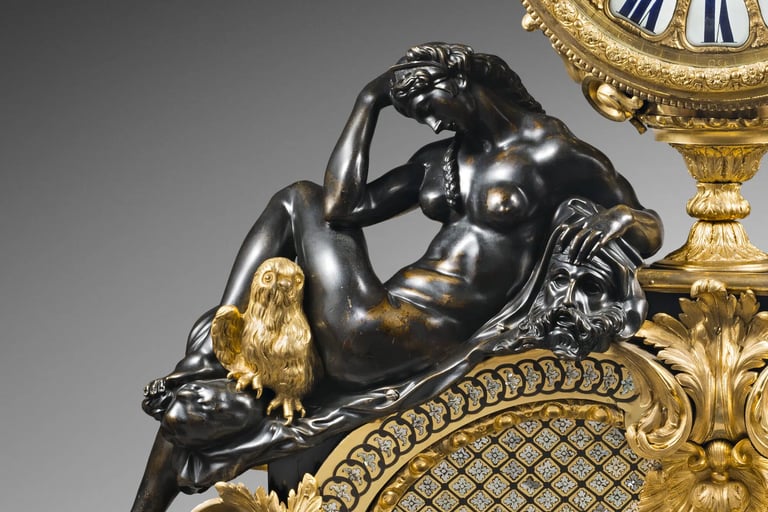
Ornate Casings: Often featured figures (like Time/Cronos), mythological scenes, sun motifs (for the Sun King), shells, and acanthus leaves.
Types: Famous examples include elaborate mantel clocks, decorative wall cartel clocks, and sophisticated astronomical clocks.
Makers: Key artisans included André-Charles Boulle, Nicolas Gribelin, and Mathieu Marguerite.
Significance:
Symbol of Power: Clocks were central to palace decor (like Versailles), symbolizing the King's absolute control over time and the universe, notes Paris Créations Virtuelles.
French Artistic Apex: Represented the height of French decorative arts, influencing European design for centuries,
Clocks during Louis XIV's reign (1661-1715) were opulent baroque masterpieces, symbolizing royal power, featuring intricate Boulle marquetry (tortoiseshell, ebony, brass), gilt bronze, and ornate figural decoration, with famed makers like Boulle, Gribelin, and Marguerite creating mantel, cartel, and astronomical clocks reflecting French Baroque grandeur for Versailles and elites.
Regency (1715 - 1723)
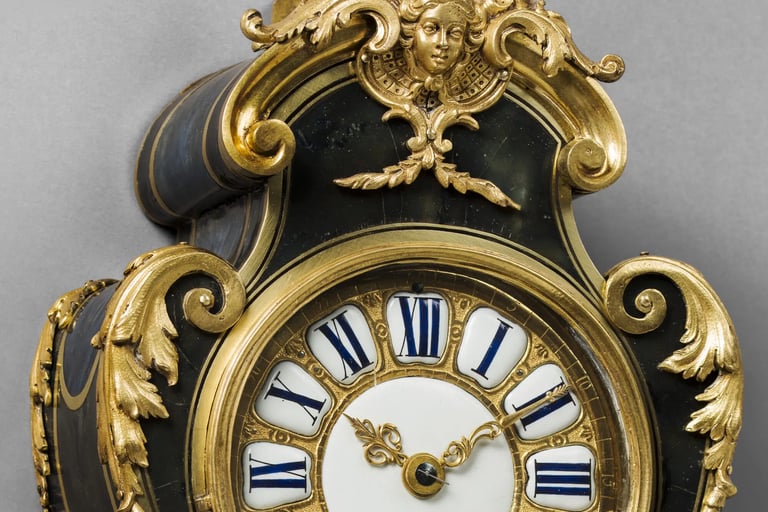
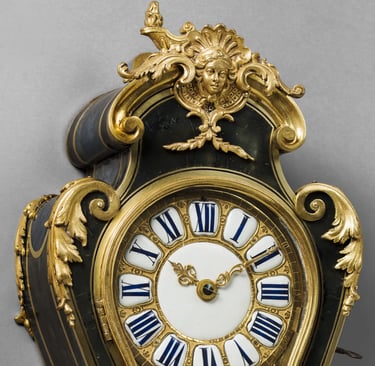
Key Characteristics
Materials: Extensively used gilded bronze, tortoiseshell, ebony, and exotic woods, often in intricate marquetry.
Design: Moved from straight, rigid lines to flowing, wavy, and asymmetrical forms, incorporating naturalistic elements like shells, flowers, and cherubs.
Types: Popular were wall-mounted Cartel clocks, often with elaborate frames, and mantel clocks, including the iconic "Oeil de Boeuf" (bull's eye) style.
Decoration: Featured white enamel dials with Roman numerals, sometimes with floral or figurative sculptures, and complex chiselled bronze mounts.
Makers: Signatures from Paris workshops, like those of Boulle or Japy Freres, indicate high craftsmanship.
Context
This period, named for the Duke of Orléans' regency for the young Louis XV, fostered artistic freedom, moving away from Baroque stiffness towards the more playful and intimate Rococo style, heavily influencing decorative arts, including clocks.te your text here...
French Regency clocks (1715-1723) marked a transition from Louis XIV's grandeur to Rococo elegance, featuring ornate gilt bronze, tortoiseshell (Boulle work), and intricate marquetry, with styles like "cartel" (wall clocks) and "oeil de boeuf" (bull's eye) popular, showing lighter curves, asymmetrical designs, and rich materials reflecting the aristocracy's shift towards sophisticated comfort.
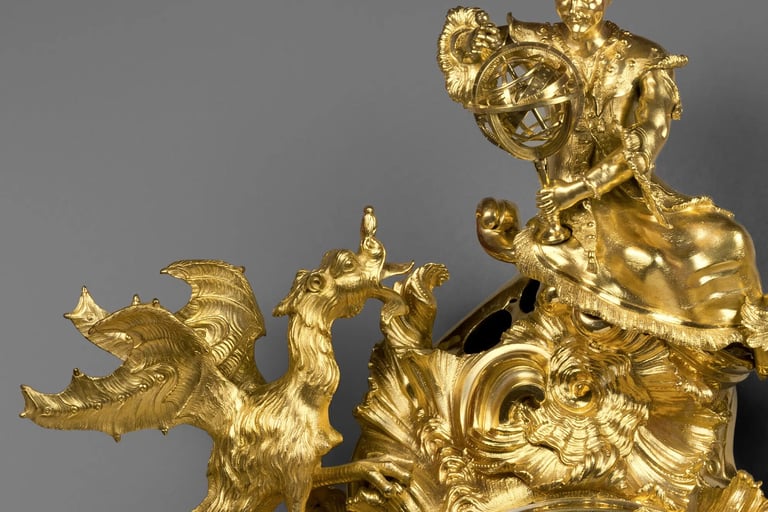
Louis XV (1724 - 1770)
Key Characteristics:
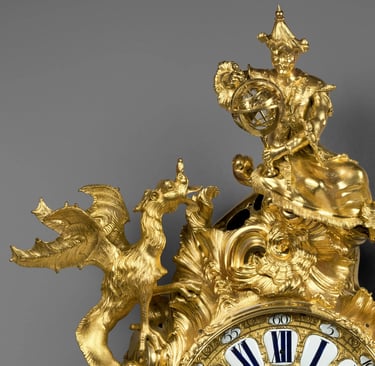
Rococo Design: Asymmetrical, flowing lines, curves, and exuberant ornamentation (e.g., swirling leaves, cupids, animal figures).
Materials: Gilt bronze (ormolu) was prominent, often combined with fine wood marquetry (inlaid wood).
Types: Popular forms include mantel clocks (often with figurative elements) and cartel (wall) clocks, sometimes with repeating chimes for bedrooms.
Craftsmanship: High-quality movements by renowned Parisian clockmakers (maîtres-horlogers) like Jean-Jacques Fiéffé, Julien II Le Roy, and Lepaute.
Influential Designers: Designs often followed goldsmiths and designers like Juste-Aurèle Meissonnier, known for Rococo's exuberance.
Examples:
Getty Museum's Pendule d'Alcove: A large wall clock with reclining figures, typical of Meissonnier's flowing designs, featuring J-J. Fiéffé's movement, circa 1735-1740.
Cartel Clocks: Elaborate wall clocks with figures of cupids, dragons, and ornate scrolling, often signed by master workshops.
Regulator Clocks: Tall, elaborate longcase clocks, sometimes featuring intricate parquetry and scientific elements like barometers, by makers such as Julien II Le Roy and Charles Cressent.
In essence, Louis XV clocks are celebrated for their artistic flair, luxury materials, and intricate mechanical quality, embodying the height of 18th-century French decorative arts.
Louis XV clocks (1724-1770) are defined by the opulent Rococo style of French decorative arts, featuring elaborate gilt bronze (ormolu), naturalistic motifs like scrolls, shells, flowers, and cherubs, often incorporating marquetry or exotic woods, seen in mantel clocks (pendules d'alcove) and wall clocks (cartels), showcasing master clock makers (penduliers) like Cressent, Caffieri, and Le Roy.
Transition (1770 - 1774)
Materials:
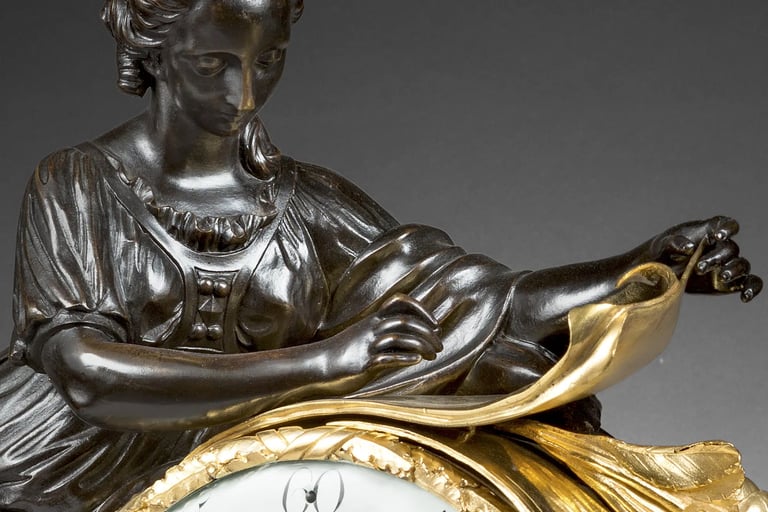
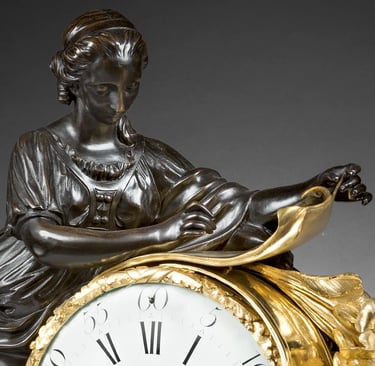
Clocks were primarily made with gilt bronze (ormolu), but this period saw an increased use of secondary precious materials like Sèvres porcelain plaques and various types of marble (often white marble or alabaster).
Design Motifs: Rococo elements, such as asymmetrical rocaille (shell) and organic forms, were gradually replaced by Neoclassical motifs. Common emerging classical elements included:
Urns and vases.
Architectural forms like columns and pediments.
Classical figures inspired by Greek and Roman mythology.
Symmetry became more prevalent in the design compared to the earlier Louis XV period.
Figural Clocks:
A popular type was the "subject clock," where the clock mechanism was integrated into an elaborate sculptural case, often with allegorical figures. Animal figures, such as elephants or lions, were sometimes used as bases, carrying the clock on their backs.
Clock Mechanisms and Dials
While the cases evolved significantly in style, the internal mechanisms were becoming more standardized, allowing for greater focus on the external artistry.
Movement Type: Most clocks utilized reliable 8-day movements with an anchor escapement and silk-thread suspended pendulum.
Dials: Dials were typically made of white enamel with Roman numerals for the hours and Arabic numerals for the minutes. Some highly decorative examples featured individual enamel cartouches (small plaques) for each numeral.
Clockmakers: Renowned clockmakers ("horlogers") of the time included Jean-André Lepaute, François Viger, and Renacle-Nicolas Sotiau, who often collaborated with master bronziers and enamelers.
Clocks from the 1770–1774 Transition period in France are a fascinating blend of the opulent Rococo style of the Louis XV reign and the emerging, more restrained Neoclassical style of the Louis XVI period. This era marks a shift towards symmetry and classical motifs.rite your text here...
Case Design and Materials
The cases from this period bridge two distinct aesthetics, moving away from purely curvilinear forms toward more structured, architectural shapes.
Louis XVI (1774 - 1792)
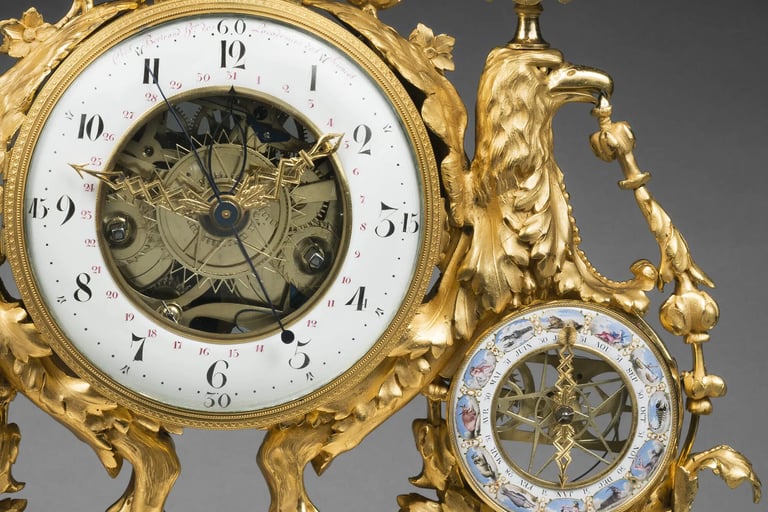
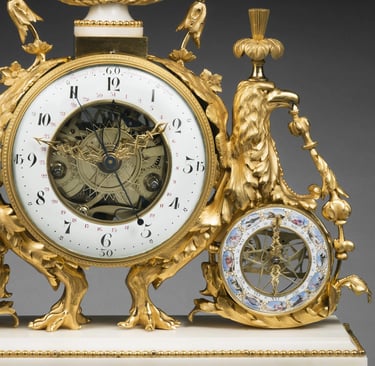
Louis XVI clocks (1774-1792) are hallmarks of French Neoclassicism, moving away from Baroque opulence to embrace classical Greco-Roman forms, featuring refined gilt bronze (ormolu), white marble, Sèvres porcelain, and motifs like military trophies, pastoral scenes, or mythological figures, embodying balanced elegance, symmetry, and fine craftsmanship from artisans like Furet et Gaudon and François Rémond.
Key Characteristics
Neoclassical Design: Inspired by discoveries at Pompeii and Herculaneum, they feature clean lines, symmetry, and architectural elements.
Materials: Common combinations include gilt bronze (ormolu) with white Carrara marble, sometimes accented with Sèvres porcelain plaques.
Motifs: Look for Roman-style figures, cherubs, putti, military trophies (helmets, quivers), floral swags, and naturalistic elements like oak leaves.
Craftsmanship: Exemplified by master clockmakers (horlogers du roi) like Bouchet, Furet et Gaudon, and bronziers like Pierre-Philippe Thomire and François Rémond, who worked under royal patronage.
Forms: Common types include mantel clocks, often with architectural bases, and distinctive lyre-shaped clocks where pendulum cords are part of the design.
Examples of Motifs
Allegorical Scenes: Depicting love (cherubs, doves) or nature/hunting.
Symbolic Objects: Cuirasses, quivers, fasces (rods with an axe).
These clocks are highly prized for their detailed artistry, blending technical skill with the refined aesthetic of late 18th-century French decorative arts, making them significant historical artifacts.
Directory (1795 - 1799)
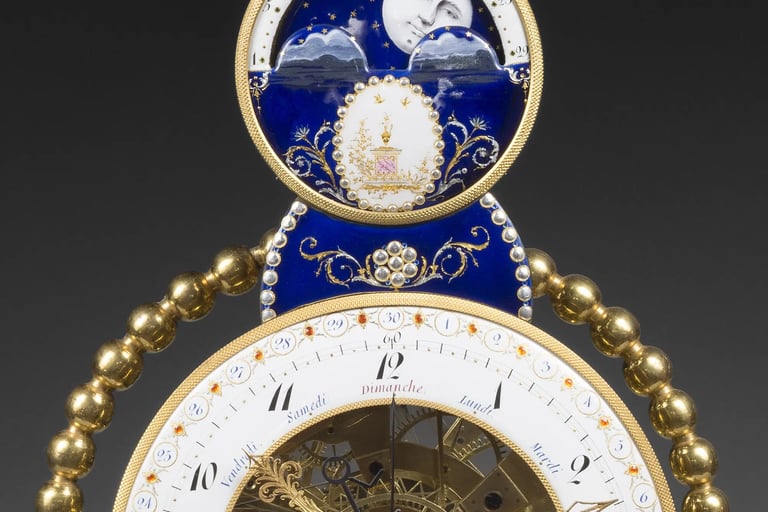
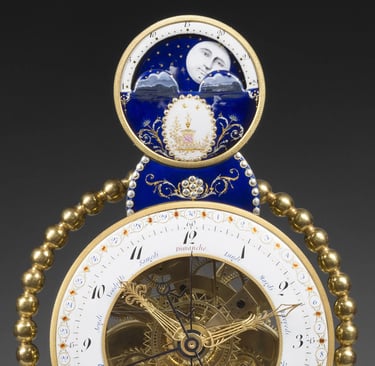
A "Directory (1795-1799) clock" refers to ornate French mantel clocks made during the French Directory period (1795-1799), characterized by lavish ormolu (gilded bronze) designs, mythological or allegorical themes (like Diana, Hebe, or Bacchus), classical motifs, and detailed sculptures, often signed by Parisian clockmakers such as Deverberie or Thomire, featuring enamel dials and intricate movements.
Key Characteristics:
Period: France, during the rule of the Directory (1795-1799), a post-Revolutionary era.
Materials: Primarily gilt bronze (ormolu), sometimes with marble, and white enamel dials.
Themes: Rich in Neoclassical and mythological imagery, reflecting the era's artistic tastes.
Design: Elaborate, sculptural, often featuring figures (goddesses, cupids, shepherds), animals (dogs), and pastoral scenes.
Movement: High-quality French movements, often with wire suspension pendulums, striking hours and half-hours on a bell, and signed by Parisian makers.
Makers: Attributed to renowned bronziers and clockmakers like Jean-Simon Deverberie, Pierre-Philippe Thomire, Chopin, and Jacquot.
Examples of Themes:
"Allegory of Fidelity" (spinner and dog)
"Joséphine" (related to Napoleon's Josephine)
"Bacchus" (God of Wine)
"Hebe Cup Bearer" (Goddess of Youth)
Consulate (1799 - 1804)
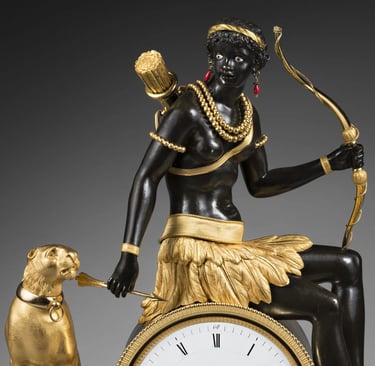
The Political Consulate (1799-1804)
Rise of Napoleon: After the coup of 18 Brumaire (Nov 9, 1799), the Directory was replaced by a Consulate with Napoleon as First Consul, holding most power.
Authoritarian Stability: It was a period of energetic state-building, bringing stability through strong rule, but curtailing press freedom and dissent.
Key Reforms: Napoleon established the Bank of France, reformed education, and introduced the Napoleonic Code (Civil Code).
Transition to Empire: The Consulate ended when Napoleon crowned himself Emperor in May 1804, marking the start of the Empire.
Consulate Style Clocks (c. 1800)
Transitional Style: These clocks bridge the simpler Directoire style and the elaborate Empire period, often using gilt bronze.
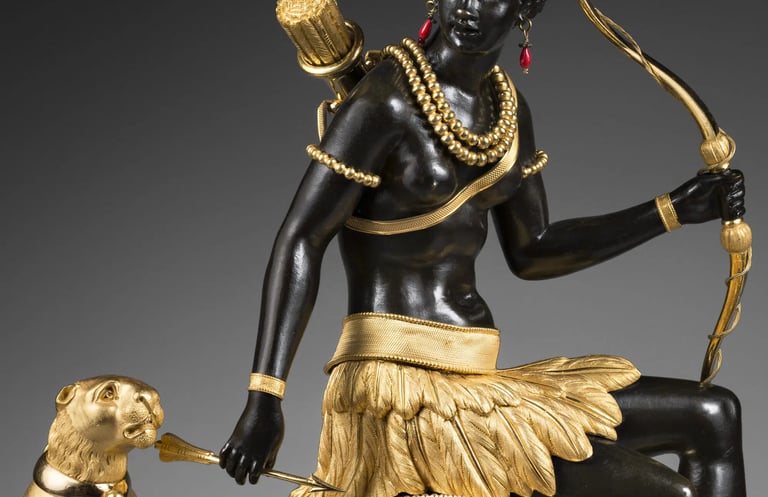
Common Motifs: They feature mythological scenes (like Phaeton), allegorical figures, classical porticos, and sometimes Napoleon's likeness or symbols of state power.
Craftsmanship: Look for finely chased gilt bronze (ormolu) with matte and burnished finishes, enameled dials, and robust mechanisms.
Examples: "Gare la Bombe" clocks (portable, bomb-themed) and large mantel clocks with sculptural elements are characteristic.
In essence, the "Consulate" was a pivotal political era defined by Napoleon's consolidation of power, while "Consulate clocks" are tangible examples of the art and design reflecting that significant period in French history.
The "Consulate (1799-1804)" Refers to the French government period where Napoleon Bonaparte was the dominant leader as First Consul, establishing strong centralized rule after the Revolution, creating lasting institutions like the Napoleonic Code, stabilizing finances, but restricting freedoms, ultimately leading to his coronation as Emperor in 1804. Clocks from this era, known as Consulate clocks, reflect this transition with classical, often bronze, styles, featuring themes of power, mythology, and the emerging Napoleonic image, bridging Revolutionary simplicity and Empire grandeur.
Empire (1804 - 1814)
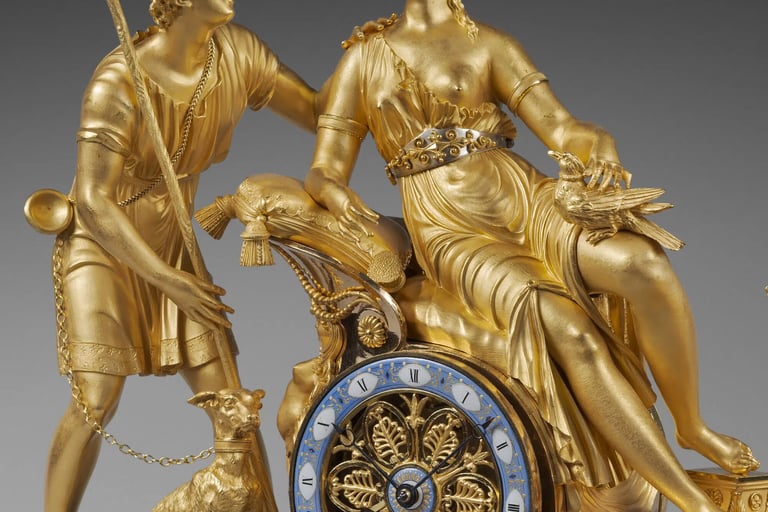
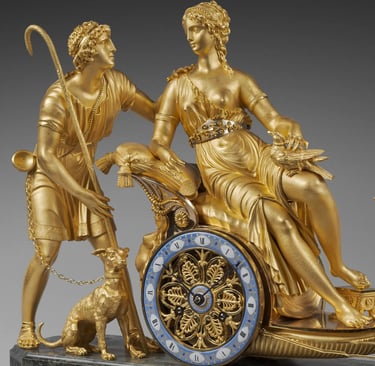
The "Empire clock (1804-1814)" refers to elaborate French mantel clocks from Napoleon's Empire period, characterized by Neoclassical designs, gilt bronze, rich marbles (like porphyry), and motifs from classical antiquity (gods, chariots) or Egypt, showcasing French power and artistic height with makers like Thomire and Ravrio crafting luxurious timepieces for the era's elite.
Key Characteristics
Period: Napoleonic Empire (1804-1814/15), extending slightly into the Restoration.
Style: Heavily influenced by Neoclassicism, celebrating Roman and Greek themes.
Materials: Luxurious gilt bronze (ormolu), patinated bronze, and fine marbles (red griotte, porphyry).
Motifs: Chariots (Apollo), mythological figures, Egyptian elements (sphinxes, obelisks from Napoleon's campaigns), and allegorical scenes.
Craftsmanship: High quality, often featuring matte and burnished finishes on the bronze, demonstrating significant artistry.
Notable Makers: Clockmakers and designers like Thomire, Ravrio, Galle, and Vaillant were prominent.
Significance
These clocks were not just timekeepers but symbols of Napoleon's imperial grandeur, reflecting France's political and artistic dominance. They are highly sought after by collectors today for their beauty, historical significance, and technical excellence.
Restoration (1814 - 1848)
Key Characteristics
Period: Napoleonic Empire (1804-1814/15), extending slightly into the Restoration.
Style: Heavily influenced by Neoclassicism, celebrating Roman and Greek themes.
Materials: Luxurious gilt bronze (ormolu), patinated bronze, and fine marbles (red griotte, porphyry).
Motifs: Chariots (Apollo), mythological figures, Egyptian elements (sphinxes, obelisks from Napoleon's campaigns), and allegorical scenes.
Craftsmanship: High quality, often featuring matte and burnished finishes on the bronze, demonstrating significant artistry.
Notable Makers: Clockmakers and designers like Thomire, Ravrio, Galle, and Vaillant were prominent.
Significance
These clocks were not just timekeepers but symbols of Napoleon's imperial grandeur, reflecting France's political and artistic dominance. They are highly sought after by collectors today for their beauty, historical significance, and technical excellence.
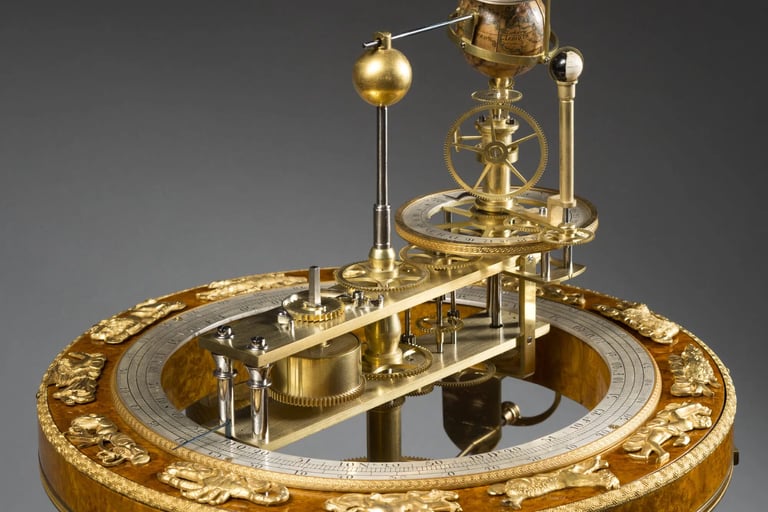
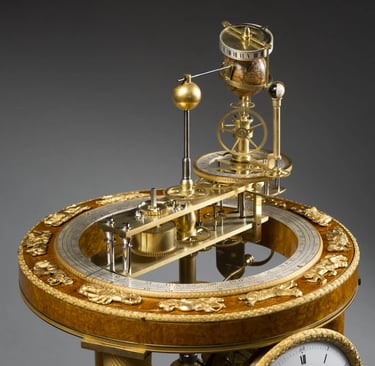
The "Restoration (1814-1848)" era in clockmaking refers to the period following Napoleon, especially in France, characterized by elaborate, highly decorative mantle clocks in gilt bronze (ormolu), featuring mythological figures, allegories (like "The Stretcher Bearers"), naturalistic themes (flowers, animals), rotating dials, and intricate mechanics, bridging Empire styles with emerging Romanticism, with prominent makers like Thomire, Ravrio, and Feuchère creating luxury pieces reflecting status and art.
Other